
What Is the Church?
Church Leadership
Understanding the roles, responsibilities, and biblical foundations of Christian leaders.
Servants, Not Lords
Christian leadership is rooted in service. Jesus himself said, 'Whoever wants to become great among you must be your servant' (Matthew 20:26). Across all Christian traditions, church leaders are called to shepherd, teach, and serve the people of God — not to exercise authority for its own sake. Jesus Christ remains the head of the Church; all human leadership exists to point people toward Him.
"So Christ himself gave the apostles, the prophets, the evangelists, the pastors and teachers, to equip his people for works of service, so that the body of Christ may be built up."
— Ephesians 4:11–12 (NIV)
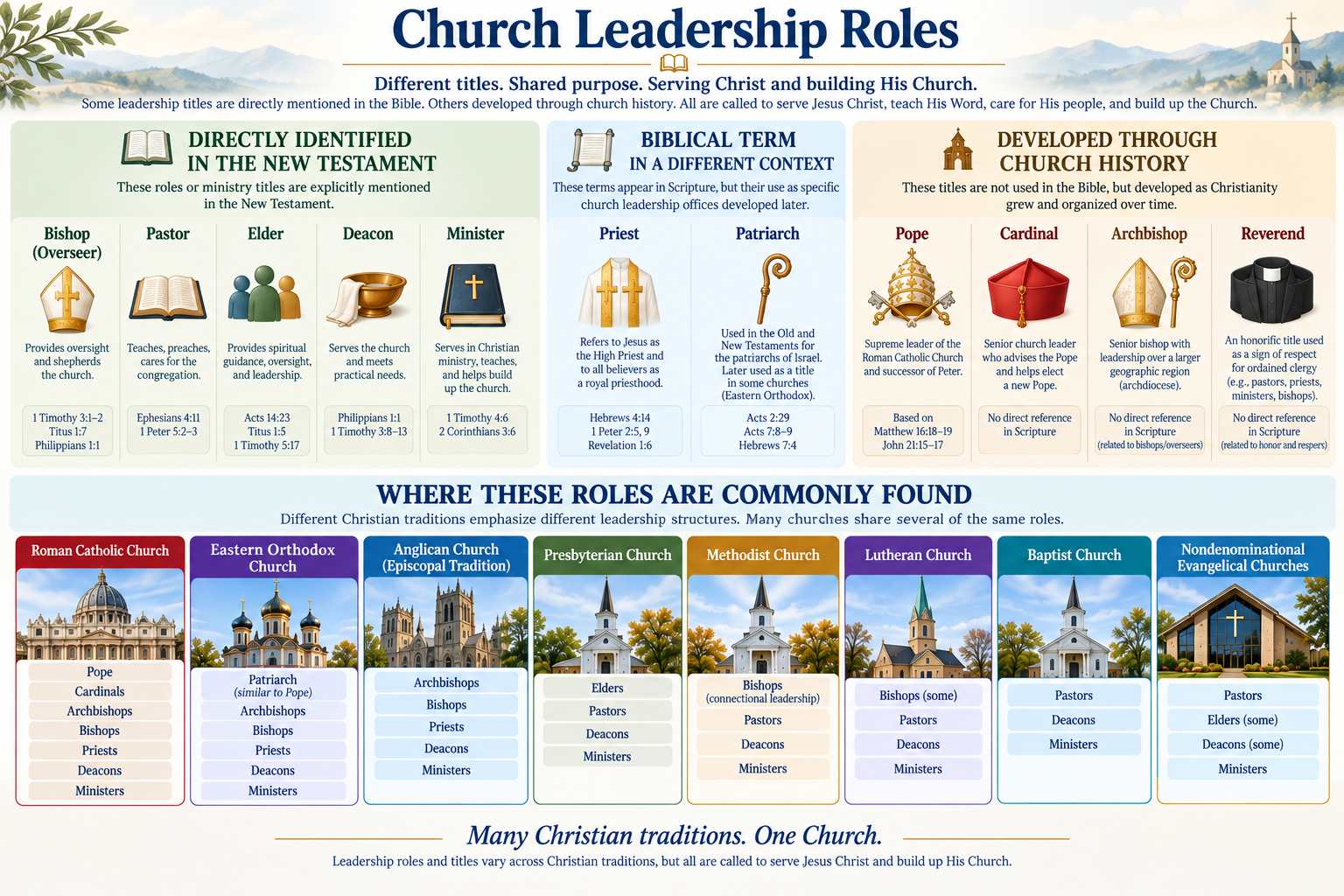
Leadership Roles
Select any role to expand its full description.
Directly Identified in the New Testament
Biblical Terms in a Different Context
Developed Through Church History
How Churches Are Governed
Beyond individual leadership roles, Christian churches organize their authority and decision-making in different ways. Three broad models of church governance have developed across Christian history.
Episcopal
Authority flows through a hierarchy of bishops. Bishops ordain priests and deacons, oversee dioceses, and guard doctrinal continuity. This model emphasizes apostolic succession — the unbroken chain of ordained leadership from the apostles to the present. Used by: Catholic, Eastern Orthodox, Anglican/Episcopal, Methodist.
Presbyterian
Authority is shared among a body of elected elders (presbyters). Local congregations are governed by a session of elders; regional bodies called presbyteries provide oversight; and a general assembly handles broader denominational matters. This model emphasizes shared leadership and accountability. Used by: Presbyterian, Reformed.
Congregational
Each local congregation is self-governing and autonomous. Members of the congregation make decisions together, often by vote. There is no external bishop or denominational body with authority over the local church. This model emphasizes the priesthood of all believers and the autonomy of the local church. Used by: Baptist, Congregationalist, many Non-denominational churches.
Leadership That Serves
Across all these titles and traditions, the New Testament is clear: Christian leadership is not about status or power — it is about service. Jesus set the example by washing his disciples' feet and giving his life for others. Whatever title a church leader holds, their calling is the same: to shepherd God's people, point them to Christ, and equip them for a life of faith.
"Whoever wants to become great among you must be your servant, and whoever wants to be first must be your slave — just as the Son of Man did not come to be served, but to serve, and to give his life as a ransom for many."
— Matthew 20:26–28 (NIV)
Continue exploring the Church