
What Is the Church?
Church History
From Pentecost to the present — how God's people grew and spread across the world.
How Christianity Developed Over Time
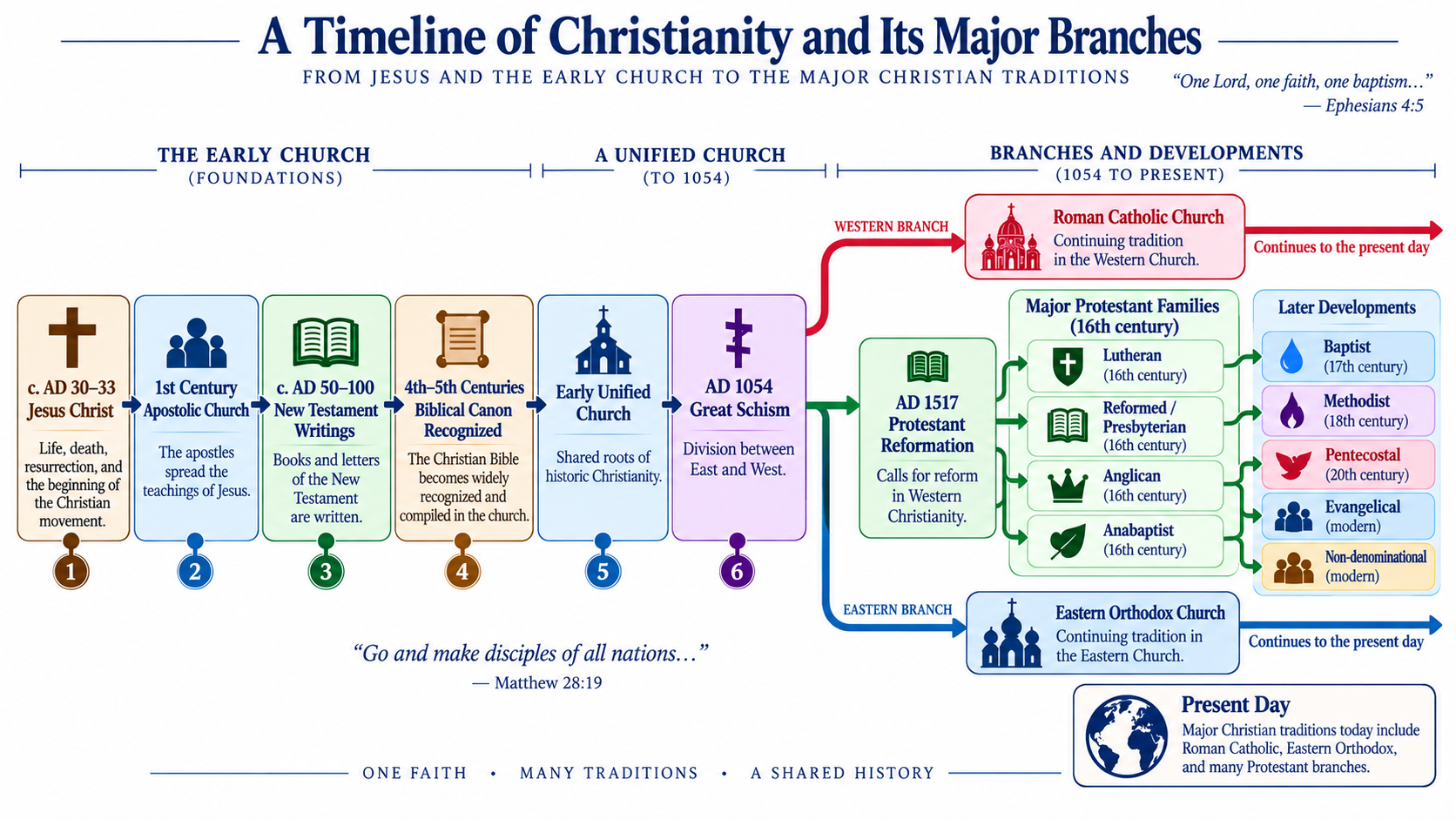
Christianity began with Jesus Christ and the early Church and developed through centuries of shared history. Over time, major traditions such as Roman Catholic, Eastern Orthodox, and Protestant Christianity emerged, with Protestant Christianity later developing into many denominations and movements. The timeline below provides a simplified overview of these historical branches and helps show how many of today's Christian expressions are connected.
Key Moments in Church History
c. AD 30
Pentecost and the Birth of the Church
After Jesus' resurrection and ascension, the Holy Spirit descended on the disciples in Jerusalem at Pentecost. About three thousand people believed and were baptized that day. The early Church devoted itself to the apostles' teaching, fellowship, breaking of bread, and prayer (Acts 2:42–47). This community of Jewish believers in Jesus became the foundation of the Christian Church.
AD 30–100
The Apostolic Age
The apostles — including Peter, Paul, John, and others — spread the gospel throughout the Roman Empire and beyond. Paul's missionary journeys established churches across Asia Minor, Greece, and Rome. The New Testament letters were written to instruct and encourage these early congregations. By the end of the first century, Christianity had spread from Jerusalem to Rome and across the Mediterranean world.
AD 100–313
Persecution and Growth
Early Christians faced periodic persecution from Roman authorities who viewed their refusal to worship the emperor as a political threat. Despite — and in some ways because of — this persecution, the Church grew rapidly. Early theologians called the Church Fathers wrote defenses of the faith (apologies) and developed Christian doctrine. Martyrs who died for their faith became powerful witnesses to the truth of the gospel.
AD 313
The Edict of Milan
Emperor Constantine issued the Edict of Milan, granting religious tolerance throughout the Roman Empire and ending official persecution of Christians. Christianity moved from a persecuted minority to a legally protected religion. Constantine later convened the Council of Nicaea (AD 325), which produced the Nicene Creed — a foundational statement of Christian belief affirming the full divinity of Jesus Christ.
AD 1054
The Great Schism
Centuries of theological, cultural, and political tensions between the Western (Latin) and Eastern (Greek) churches culminated in the Great Schism of 1054. The Pope in Rome and the Patriarch of Constantinople mutually excommunicated each other, formally dividing Christianity into the Roman Catholic Church in the West and the Eastern Orthodox Church in the East. This division has never been fully healed.
AD 1517
The Protestant Reformation
Martin Luther nailed his 95 Theses to the door of the Wittenberg church, challenging Catholic practices — especially the sale of indulgences — and calling the Church back to Scripture. His emphasis on Scripture alone (sola scriptura), grace alone (sola gratia), and faith alone (sola fide) sparked a movement that spread across Europe. John Calvin, Ulrich Zwingli, and others developed distinct Reformed traditions. The Reformation gave rise to Lutheran, Reformed, Anglican, and many other Protestant churches.
18th–19th Century
Revivals and Global Missions
The 18th and 19th centuries saw powerful revivals — including the First and Second Great Awakenings in America and the Wesleyan revival in Britain — that transformed societies and gave birth to new denominations including Methodist, Baptist, and Pentecostal movements. The modern missionary movement sent Christians to every continent, translating the Bible into hundreds of languages and planting churches around the world.
20th Century–Present
Global Christianity Today
Christianity is now the world's largest religion, with over 2 billion adherents across every nation. The center of gravity has shifted from Europe and North America to Africa, Asia, and Latin America, where the Church is growing rapidly. The Pentecostal and Charismatic movements have become among the fastest-growing expressions of Christianity. Ecumenical dialogue continues between traditions, while the Church faces new challenges and opportunities in a rapidly changing world.
Continue exploring the Church
Discover Christian traditions and leadership.