
Waypoint 8 of 10
Bible Translations
Understanding the English Bible translations available to you
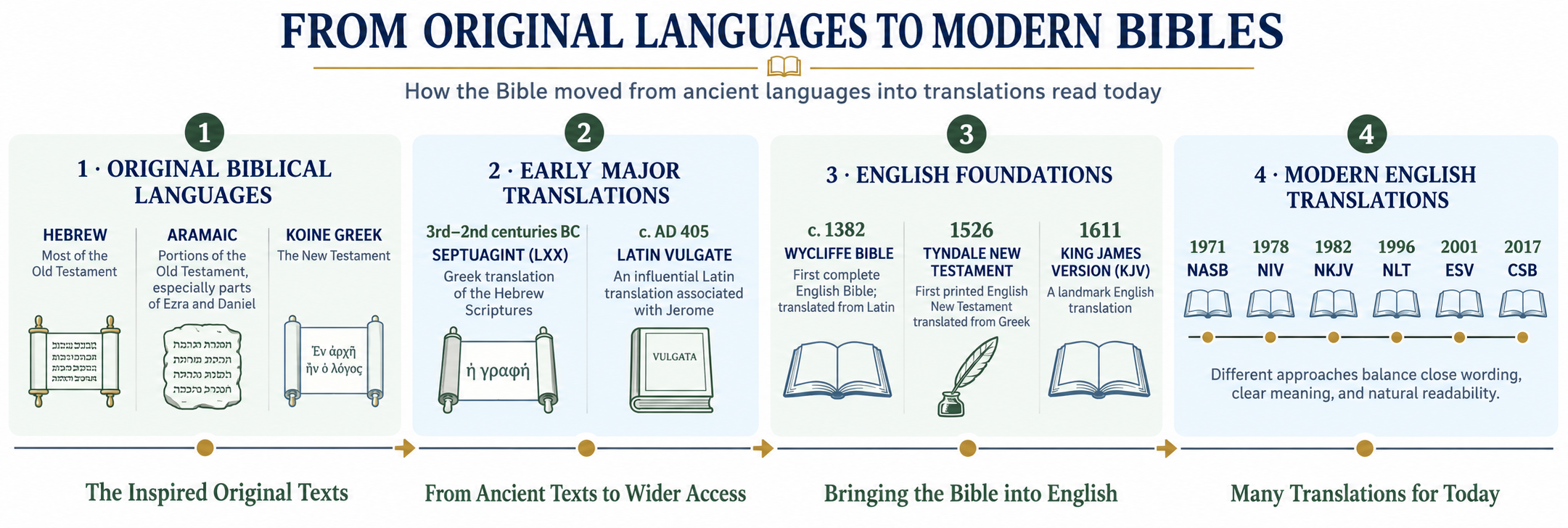
The Bible was not originally written in English. The Old Testament was written primarily in Hebrew, with portions in Aramaic, while the New Testament was written in Koine Greek. Modern Bible translations are produced by teams of scholars who study ancient manuscripts and translate the original-language texts into contemporary languages. Because languages differ and translators make different choices, English Bibles sometimes use different wording. Some translations stay closer to the original wording and sentence structure, while others emphasize communicating the meaning in clear, natural English.
How the Bible Reached Us
The timeline below follows the Bible's journey from its original languages through early translations to the major English versions available today.
Quick Comparison
| Translation | Style | Best For |
|---|---|---|
| NIV | Clear, modern, and easy to understand | General reading, personal study, and those new to the Bible |
| ESV | More literal and formal | Bible study, memorization, and teaching |
| NASB | Very literal and precise | In-depth Bible study |
| CSB | Clear and balanced | Personal study, everyday reading, and families |
| NKJV | Traditional language with modern updates | Readers who appreciate traditional biblical language |
| KJV | Traditional and literary | Readers who appreciate historic and traditional language |
| NLT | Very readable and conversational | Beginners and devotional reading |
About Each Translation
New International Version (NIV)
The NIV is one of the most widely used modern English translations. It provides a balance between readability and faithfulness to the original biblical languages.
English Standard Version (ESV)
The ESV follows a more word-for-word approach while remaining readable. It is widely used in churches, seminaries, and for personal Bible study.
New American Standard Bible (NASB)
The NASB is known for closely following the wording and structure of the original Hebrew and Greek texts. It is a preferred choice for detailed study.
Christian Standard Bible (CSB)
The CSB seeks to balance accuracy with natural, readable English. It is suitable for personal reading, group study, and family use.
New King James Version (NKJV)
The NKJV preserves much of the traditional style associated with the King James Version while updating archaic language for modern readers.
King James Version (KJV)
The KJV has had a tremendous influence on English-speaking Christianity and literature. Its language is formal and poetic, reflecting 17th-century English.
New Living Translation (NLT)
The NLT uses contemporary language and emphasizes communicating the meaning of the original text in a natural, easy-to-read way.
Which Translation Should I Read?
There is no single translation that every Christian must use. A good translation is one that helps you understand God's Word accurately and encourages you to read it regularly.
New to the Bible
NIV, NLT, or CSB
Balance of Readability and Literal Wording
ESV or CSB
Detailed Bible Study
NASB or ESV
Traditional Language
NKJV or KJV
A Good Starting Point
If you are new to reading the Bible, the NIV, NLT, or CSB are good places to start. They are clear, accurate, and widely available. As you grow in your study, you may want to compare multiple translations to gain a fuller understanding of the text.
A Good Approach
Many Christians read from one translation regularly and consult others for comparison. Using a study Bible or a Bible app that allows you to view multiple translations side by side can be a helpful practice.
The most important thing is to read the Bible regularly in a translation you understand.